
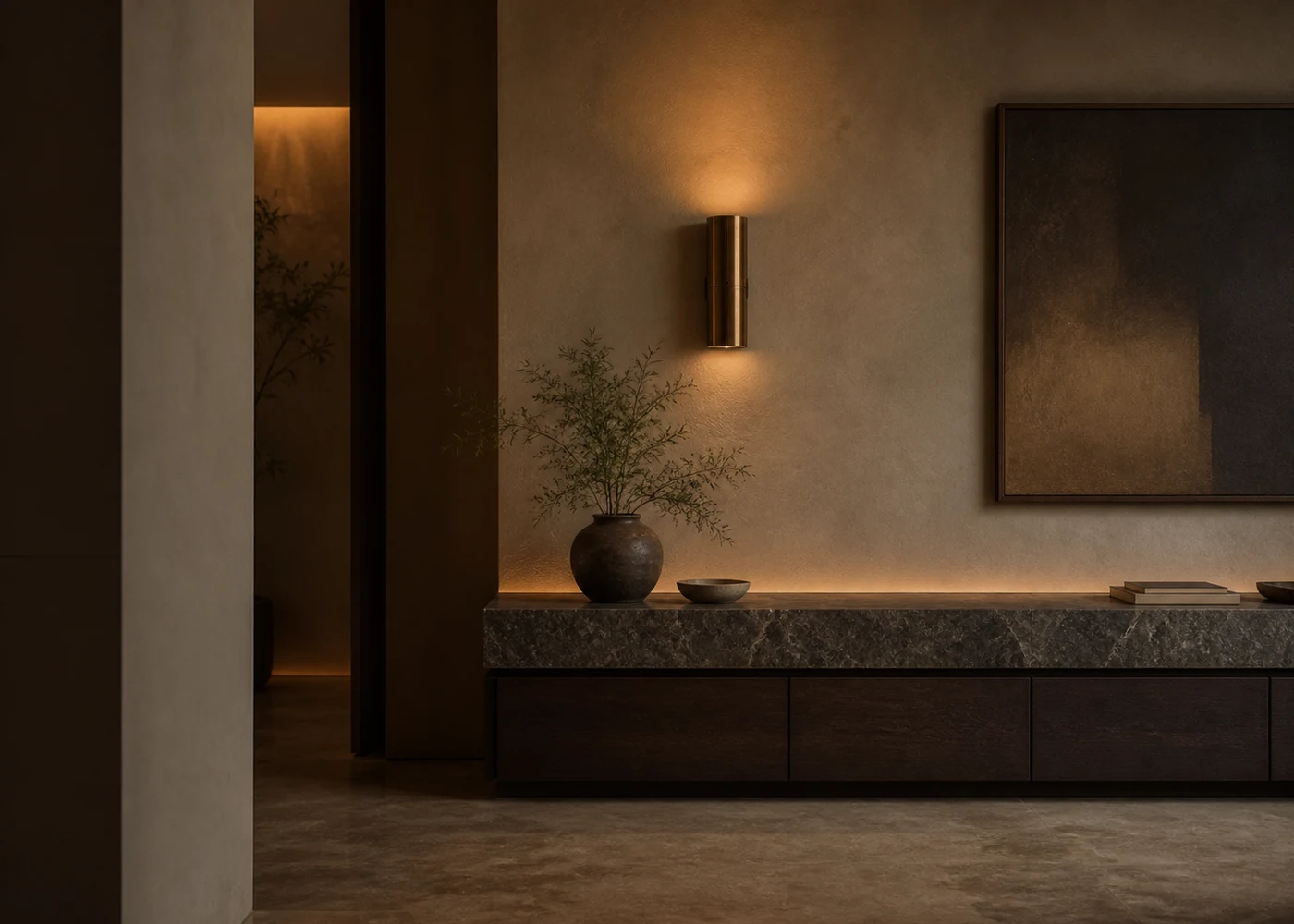
The most useful lighting review usually happens when the room is almost dark. Drawings can show a ceiling grid, fixture type, and switching circuit, but they cannot show whether a wall will feel restful at 8:30 in the evening. On one recent residence, the plan looked complete until we stood in the half-finished living room after sunset. The downlights were technically adequate. The room still felt restless.
Warm light is often mistaken for a product decision: choose 2700K, buy a brass fixture, and the room will become soft. It is not that simple. Lower colour temperature helps living spaces feel more forgiving, but glare, placement, reflection, and dimming decide whether the warmth reads as atmosphere or as theatrical amber. A bright point source against a dark wall can feel harsher than a cooler lamp placed correctly.
Lighting research is useful because it keeps the conversation disciplined. Colour temperature describes the apparent warmth or coolness of the source, but the eye reads contrast first. A lamp that is technically warm can still feel aggressive if the surrounding surface is too dark, if the source is exposed, or if the beam lands on polished stone at the wrong angle. The atmosphere is made by relationships, not by the Kelvin number alone.
A useful technical distinction is ambient, task, and accent light. Ambient light allows the room to function. Task light supports reading, cooking, dressing, writing, or grooming. Accent light gives depth to a wall, shelf, artwork, niche, or object. The mistake is making every layer visible. When all three layers announce themselves, the room begins to look wired rather than composed.
In Indian homes, the reflective conditions can be unforgiving. Polished stone floors, glossy tiles, mirrors, glass shutters, and light paint can multiply a small glare problem. A dining pendant that looks beautiful in a showroom may throw a hard reflection into a dark window at night. A bathroom mirror light can flatten the face if it is too high or too cool. A television wall can become tiring when the strongest light sits behind the viewer.
We start by choosing what should stay quiet. A living room often needs one softened vertical plane, not equal brightness everywhere. A bedroom may need light low enough to help the body slow down before sleep. A kitchen needs practical task light at the counter, but the dining edge beside it can hold a warmer, lower layer. The house should not feel like one switch turned everything on.
Colour rendering matters as much as colour temperature. Stone, wood, fabric, and skin are full of small colour differences. A poor light source can make an expensive stone look flat or a smoked oak surface look muddy. Before finalising decorative fittings, we prefer to test samples under the light that will actually be used, especially for plaster tones, veneer, linen, and brass.
The source also needs somewhere to disappear. Concealed coves, shielded linear light, deep-set picture lights, and small lamps can all work if the eye receives the lit surface before it notices the fixture. This is where detailing matters. A cove that is too shallow shows a hot line. A niche without a return edge spills light in a crude way. A downlight placed without regard for furniture can light the top of a head instead of the table.
Dimming is not a luxury feature in this context. It is part of the atmosphere plan. A room that hosts guests, family meals, television, reading, and quiet evenings cannot be held at one intensity. Multiple circuits and clear switches give the client a way to inhabit the room instead of fighting it. The switch plate, in that sense, is not a technical afterthought. It is an interface with mood.
We also write a lighting scene in plain language before it becomes a drawing. Dinner with guests. Quiet television. Reading beside a window. Early morning kitchen. Guest bathroom at night. Once the scenes are named, the plan becomes less arbitrary. The electrician, the client, and the studio can all understand why one circuit needs to fade and another needs to stay practical.
The premium decision is often subtraction. Remove a visible downlight from the seating axis. Pull a beam away from polished stone. Let a corner remain in shadow. Place one brass sconce where the hand pauses near a passage rather than repeating it as decoration. Good warm light does not make a room glow everywhere. It gives the room permission to have depth.